Showing posts with label issues. Show all posts

Monday, February 2, 2015

The Impostor

I don't know if you were in the "popular" crowd in high school, but I really wasn't. I was on the pom squad, which was sort of a "popular" group, but I was the happy nerd on the pom squad. I was the one who was granted the "Albert Einstein Award" at the year-end pom banquet, and my 4.67 grade-point-average seemed to be my claim to fame on the squad. Through and through, I was really an Honors kid and I belonged with the Honors crowd, but I also spent time with the pom girls because I could do a switch-leap and a triple pirouette. While I had good friends on the squad and am still good friends with some of those ladies today, my true place of comfort was with the Honors kids. In that sense, I never really had a place with the popular crowd to which most of the pom girls belonged. It sort of felt like 'us' and 'them.' Not 'us' versus 'them,' because there was no animosity from either side. It was just that there was us, and then there was them.

 
Flashback!
Recently I have become acquainted with the idea of the "impostor syndrome."   Basically, the idea of the impostor syndrome is that a person finds it impossible to internalize their own success and believe that they could actually be responsible for it. Instead, they attribute their success to luck or some other outside factor. Though they may appear confident on the outside, when they look around they do so with a fear that somehow their incompetence will be exposed for all to see, and suddenly everyone will realize that they don't really know what they're doing. Research indicates that most people, 70 percent actually, feel like an impostor at one point or another in their lives. I know that when many of my colleagues and I were doing our pre-doctoral internships, we often felt like impostor therapists--that we were acting like therapists with real clients, but with no real knowledge of what we were doing and a real insecurity that we were unintentionally ripping people off. Our clients thought they were coming to see therapists, but what they were really getting was just us! The truth was, we actually did know what we were doing, but we were just scared shitless. Statistics pretty much indicate that at every work place, at least one person walking around feels like they don't deserve to be there and that their colleagues are infinitely more qualified than they are. They probably also think they are the only ones that feel this way, but in fact many of their colleagues feel the same way that they do.


While I have briefly felt like an impostor in both my career and in parenthood (you should have seen me freaking out on the drive home from the hospital with newborn Silas! "What if we accidentally kill him? Don't they know that we don't know what we're doing?!?!"), the main place in life where I feel like an impostor is in my running. As you likely well know, I sign up frequently for races, and at every race I feel like it's me and them. They're the real runners, and I'm the joker who has no idea what she has gotten herself into. I find myself at starting lines waiting for the gun and scanning the runners around me, wondering which ones will beat me and if there are any that I think I can finish in front of. The latter group is much smaller comparably, at least in my mind. The judgments that I make are generally based on foolish nonsense, such as how nice their shoes are, what their postures are, and how close they position themselves to the starting line. If they have nice gear or awesome legs or a water bottle strapped to their backs, I think, "Oh, crap on a stick." Anxiety kicks in and I often begin questioning myself; I think, 'These people are real runners, and I'm still just not cutting it." I may look the part, but my true folly will be exposed once the gun sounds. I've told myself things like "When I can run a 5K in 30 minutes," or "When I can run four miles," then I'll call myself a runner. Then I'll really be one of them.


It's perfectly ridiculous when I say it aloud and type it out. Of course I'm one of 'them.' As I've grown over the last six months and become a stronger and faster runner, I have cheated myself out of a really cool identity, one that I earned the first moment I ever decided to strap on my shoes.

I cheated myself out of letting myself think I was a runner.

What I've learned in only the past two weeks is the ridiculously simple truth that you're a runner when you run. Get this: when you run at all--even a little bit--you're a runner. You don't have to earn membership into that crowd with prescribed times, distances, or training. Most of those runners never thought I didn't belong. If they thought of me at all, they probably saw me as a fellow runner. What I've even learned is that probably many of them looked around at the rest of us with the same sense of anxiety as I did, feeling like an impostor at the race.

Recently I have hit a lot of those prescribed marks that I burdened myself with as an entry into the supposedly-elite class of runners: now I can run a 5K in 30 minutes. Now I can run four miles. Now I consistently finish in the top half of all racers and in the top quarter of all females in my age group. I'm a stronger runner than I was when I first started, but I'm no more of a runner now than I was then. I still want my goals just as badly, and I still get side stitches sometimes trying to get to them. Why in the world did I ever think I had to earn my way in? I already belonged.

Here's what I say. You run well on the elliptical? Great! You're a runner. You like the treadmill better, or the outside hills, or the trail, or the neighborhood sidewalks? Fantastic! You're a runner! You run in cotton t-shirts instead of techy gear? Awesome. You're a runner. You run half a mile each time you go out? Yup, you're a runner. Sign up for a 5K, and ask me to run with you, and I will join you. Why? Because we're both runners, and that's what runners do. There is no "us" and "them." When you strap on your shoes (which I really shouldn't say because some people run barefoot and we can't exclude them!) and start putting one foot in front of the other, there is only "us."
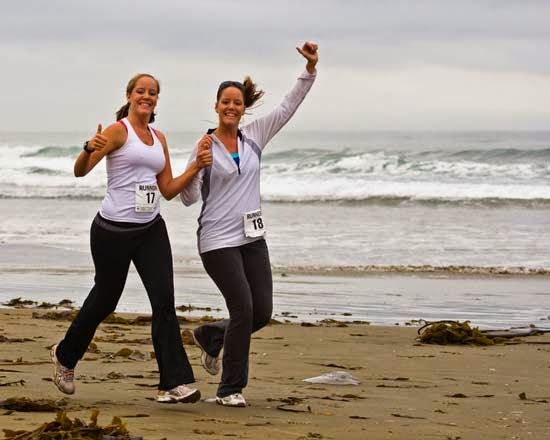
That's totally you and me, happy because we're runners!

Yup, we kicked butt, because we're runners!

Tuesday, September 9, 2014

One Hand Tied

Last week in the news, one of the primary topics (sadly) was the hacking and leakage of nude photos of several female celebrities, most notably Jennifer Lawrence. Images that were taken by these women and were intended for private, personal use were hacked from their cell phones and put on the internet for a world of Peeping Toms to see. Apple has reported that the leakage was not due to a vulnerability of iCloud, but the images were taken from online storage devices that I can't begin to explain. See BJ's blog if you're interested in that techy kind of stuff.


Much of the response to this exploitation seems reasonable to me: a large number of individuals see this as a breach of moral conduct on the part of the hackers, believe that the hackers should pay for their crimes (yes, I said crimes), and do not place blame upon those whose photos were stolen. There is a subset of society, however, that immediately lashed out at Lawrence and others, blaming them for their role in the 'scandal' and admonishing them to do better next time. I won't even link to these latter articles because I don't want to draw further attention to them.

The complexity of problems within this culture is too large in breadth to expand upon here, but much of it boils down to one very large dysfunction: the sexualization and objectification of women. It is undoubtedly one of the largest problems that our society has created, and it is also one of society's biggest stumbling blocks in terms of social progress. If women are not viewed as more than what they can do for men sexually, then this country is essentially operating with one arm tied behind its back. We will never succeed and reach our potential as a collective unit if one half of us is limited by the other--generally speaking, as I am fully aware that there are decent, active men working to silence the idiots amongst us.

Why is this country so uncomfortable with the idea of women having sexual rights? The 'blame the victim' mentality held by so many people, including many women, is as damaging a notion to the women's rights movement as has ever existed. Doesn't a woman have the right to wear the clothes she wants without being held responsible for how it makes a man feel? Doesn't a woman have a right to have a drink too many and not get sexually taken advantage of? Isn't it unfair that a woman gets raped by a turned-on male who says he couldn't help himself because she was 'asking for it' by the way she looked or the way she flirted with him? Doesn't it suck that a woman can get raped by a man and, when she tries to press charges against him, the fact that she was drunk is a strike against HER? And here, with the Jennifer Lawrence situation, isn't it scary that a woman can take nude photos in the context of a private relationship, have those photos unethically hacked, and then we turn to her and chide her for not being more responsible, for not having stronger passwords or for having a nude photo of herself in the first place? Imagine this for a moment: replace the words "Jennifer Lawrence" with "small business" and replace " nude photos" with "financial statements." If a hacker got into iCloud and accessed the financials of a business, then blackmailed that business and made their account information available for all to see, that would be a legal issue. What in the world is the difference? Is it because Jennifer Lawrence is a person and not a business? Or is it because the nature of what was leaked is not as important as money---it's only the body of a woman?

So, again, why is this country so uncomfortable with the idea of women having sexual rights? I think it's because, in acknowledging those rights, society has to embrace the notion that women are individuals with faces, aspirations, and personalities--and sacrifice the deeply, long-held notions that women are just faceless bodies, just hot commodities to compare or disparage, just bitches when they're angry and hos when they're participants in sexual activities, just punching bags when others are angry. When we as a society can learn that a woman has a voice and right when it comes to her own decisions and her own body, and that her body is for herself to share with whomever she chooses, then a huge number of problems in this country will begin to subside. We will see less violence against women. We will see less pornography. We'll see more women contributing with their full potential, in whatever way they feel most enriched, and we will see more fulfilling sexual relationships. We will see more legal action when women are sexually exploited, and we will see less blaming the victim when sexual assaults do take place. We will see a return to the normalization of breastfeeding in public, because people will reject the notion that breasts are purely sexual objects and thus won't be disgusted and uncomfortable with the idea of using boobs to feed babies. We will essentially see a country operating with no hands behind its back, with all of its brains and talents being used to drive us full-throttle into the betterment of life for us all. Be you female or male, use your voices, and use them for good.You may be surprised to find out just how loud and strong they are.

Sesame Street approves!


For a similar past musing, check it.

Friday, August 15, 2014

Meet George Jetson (With Fresh Eyes)

The other day, an argument over music selection ensued from the backseat of the van. Silas, always the proponent for Wee Sing Dinosaurs, was duking it out with George, who was arguing in favor of Truck Tunes. When I say argument, of course, what I really mean is each boy shouting his selection louder than the other ad nauseam. Ever the mediator, I suggested the solution of Truck Tunes on the way to the grocery store and Wee Sing Dinosaurs on the way home. This was met by cheers from George and wails from Silas, who loudly grumbled, "I'm not even going to listen!! (pause) But I have ears so I have to."

This was the exact sentiment that I felt a few weeks ago when I made a poor decision and allowed my kids to watch an episode of The Jetsons. It all began earlier that afternoon at a public library, where we happened to be looking through the Children's DVDs with no particular selection in mind. It was easy enough: Silas wanted something to watch, and I happened to spot one of my favorite cartoons as a kid, now on DVD. I picked it up and asked, "How about this?" I explained to Silas that it takes place in the future, and that all of the houses are high in the sky, the cars fly, and the Jetsons employ a robot. Sold! We checked out the DVD and I walked out of the library happy to have the chance to show Silas what cartoons were like in my day---that is, the good ole' days.

Wow. In case I had forgotten, those good ole' days were the early 1960's (not my day, just to be clear), which held some really antiquated views on things. First of all, I think they were racist. Absolutely everybody in the future is white, according to The Jetsons. Second, the gender stereotyping was absurd. I'm really not sure what I expected from a cartoon made so many years ago, but it seems to be prevalent through the entire cartoon. Beginning with the opening credits, George is depicted as a career man, and "Jane, his wife!" is a compulsive spender of George's earnings. He offers her a few dollar bills to placate her, and she grabs the entire wallet. So much for financial planning and budget-making together as partners. I knew that what was to come was probably not great as soon as BJ and I met eyes, and we were literally 15 seconds into the episode!


I wish I could tell you that it didn't get any worse than this, but it did. The episode we watched was titled "Las Venus," and is based on George and Jane celebrating their wedding anniversary with a getaway to the space-age equivalent of Las Vegas. After they arrived, Jane left to, of course, go shopping for what she termed "a Saturn bikini." She demurely offered George the description of a swimsuit that has "rings in all the right places." What?? I'm letting my kids watch this? It obviously went right over their four-year-old and two-year-old little heads, but good grief! I wasn't expecting sexual innuendos from this enterprise.

The sexual innuendos continued, sadly. George was confronted by his boss via satellite, and he insisted that George visit with a potential client who was also vacationing in Las Venus. He promised George that the account was a big one and would result in a promotion for George and a personal secretary who, the boss indicated, had been referred to by many as "Heavenly Body." The writers apparently thought that George had no brain and no self-control, because he became ridiculously google-eyed over the possibility of scoring such a prize!! A secretary with a hot body! The look on his face was disgusting. As the episode unfolded, George did in fact meet with the client, who apparently happened to be a good-looking female. Time after time, George's character was dumbed down to be an ogre who could not articulate a single sentence while in the presence of this woman. He ended up looking like a blathering fool.
George made plans to meet with this woman for dinner, even though he was on vacation with Jane. The problem, really, was that he neglected to tell Jane about it. That evening, as he was dining with Jane, he seemed to have forgotten about his appointment and then suddenly remembered that he was scheduled to meet with this client. I'm not sure how he forgot, but okay. Because he felt he couldn't be honest with his wife, he made an excuse to leave her and he hurried to meet his client, who was in another restaurant. As he was blathering with the client, he again seemed to suddenly remember, "Oh! I have a wife! Better hurry back!" And so back and forth he went between women, each time with the sudden remembrance that he was supposed to be somewhere else. Object permanence, not achieved.

The episode, and I am assuming the entire cartoon, is an insult to women and to men. Women made no valuable contributions to anything in this episode and were generally viewed as sexual beings. Men were made to look like dumb oafs who are incapable of speaking in the presence of beauty, incapable of remembering simple plans, and guided by their sexual impulses. People of color, apparently, don't even exist! I couldn't wait for the episode to conclude and wished that I didn't have ears. I suppose that we could have stopped the show in the middle of it, but our children would have reacted as though we had thrown their dessert into a litter box. Probably. Maybe I don't give them enough credit. We could have turned off the show and explained to our children that The Jetsons aren't allowed in our home because we don't appreciate the objectification of women. Surely they would understand that, right? Somehow, though, that didn't seem like the best idea at the time. So we finished the episode and then quietly returned it to the library. The next time The Jetsons came up in conversation, we told them it had been due back at the library. Someday we can have that conversation, but not today.

Some people would say that we're overreacting, but the truth is that kids pick up a lot more than we often give them credit for. If BJ and I allowed our kids to continually watch examples that endorse these kinds of stereotypes, exclusions, and objectifications, then we risk this becoming the norm that our children think is acceptable. The ideas may gradually implant that women are good for shopping, that men become foolish around women other than their partners, that white people are the only ones that matter. I don't think so. Why even introduce those notions, just to combat them? I think we'll stick with PBS Kids shows like Wild Kratts. My kids learn valuable information about animals and their habitats while observing teamwork, kind brotherly interactions, an African-American presence in the cast, and tons of cool scientific inventions that are masterminded by a female named Aviva. This seems like a much better idea. In the meantime, I'll stop reminiscing about how things were better in the days of yore.
Wild Kratts
Brotherly cooperation in action


Tuesday, March 18, 2014

Under Cover No More


For those of you who may not have heard, my littlest kiddo was hospitalized with RSV at Children's for four days in the beginning of February. To say the very least, BJ and I were distraught and concerned about our six-week-old little guy as he struggled to breathe, but before he was admitted to the hospital we didn't realize how bad it had gotten. Van was truly in respiratory distress and was illustrating what the medical staff termed "retracting" (a word I quickly came to understand well) in order to breathe because he wasn't getting enough oxygen. On Super Bowl Sunday at around noon, we got the green light from a friend of mine who works as a physician's assistant in an ER, telling us that we needed to take action and get Van into Children's ER because his struggles were significant. It took little time for me to gather some necessary items that we might need for Van. My dad arrived to drive me, and I was out the door.

Within that five-minute scramble, I made a semi-significant decision for Van and myself--I abandoned the nursing cover that I always breastfed him under. Now, at that point in time Van had to make the choice between eating and breathing because he couldn't do both, and naturally he was choosing to breathe. Still, I thought he may change direction and eat in the ER, so perhaps I should pack my cover just in case. One look at it though, pretty as it is, and I immediately felt disgusted and angry. I muttered aloud to BJ, "Forget the stupid cover. I'm not taking it. If someone has a problem with me feeding my baby in a children's hospital without a cover, they can screw themselves." Simply put, there wasn't an iceberg's chance in hell that I was going to put my poor little guy who could barely breathe under a stuffy cover to help some possible random stranger feel more comfortable about perhaps seeing a flash of my breast. I was suddenly so angry about the nursing cover, and when that emotion combined with my panicked feelings about Van, it suddenly seemed like an easy decision to leave the cover at home. The flash of anger, I believe, was born from being repeatedly told in social media that I'm doing something I should be ashamed of by feeding my baby in a place other than a bathroom. If you don't believe me, check out this TMZ article lambasting Selma Blair for breastfeeding her child in public...and then for bonus irony, check out the photos at the bottom of the page of scantily clad women somehow deemed socially acceptable promoting other articles that have nothing to do with breastfeeding, and decide which photos are actually more revealing!)

I hung my nursing cover in the mudroom on my way to the hospital six weeks ago, and I've only used it on one occasion since then.

On the Mend
Now, don't get me wrong, dear reader. I'm about as interested in you catching a glimpse of my breast as you are about seeing it yourself, which is to say not at all. I am an exhibitionist only by Middle-Eastern standards; my swimsuit has shorts, for heaven's sake, and I'm not talking about the sexy hot pants kind. But what I'm really not interested in is forcing my sweet baby boy to eat his meals under a hot, stuffy cover that he hates. His breathing problems have gone, but my semi-posttraumatic feelings of panic are very much there whenever I think about covering him up and compromising his breathing. Believe me: once you go through that as a parent, you don't come back unchanged. So instead I choose to be discreet, using scarves or receiving blankets or Van's head to help facilitate coverage without actually covering my baby completely, and nurse my baby without a cover in public. I feel that doing so is making the best decision for Van and me. I will always be polite about my coverage, but I won't spare any words for the first stranger who chooses to confront me on the decision (hopefully no one will). My exception for using the cover would be if I am a guest in someone else's home that isn't family or a close girlfriend.

My friend Laura, who is a lactation consultant, sent me a video of a song written by an Australian mother who grew tired of the dirty looks that she got when she nursed her baby in public. Hilarious as the video is, it's truly a sad commentary on the state of breastfeeding in the western world today. Why mothers have to defend themselves at all about where they choose to feed their children (and by what means and up until what age) is a trigger point for BJ and me. The over-sexualization of breasts detracts from their actual intended purpose, which is to feed little nurslings. The lyrics of this song are quite clever and make the point that breastfeeding mothers are not actually out to ruin people's days by feeding their baby. Here are the chorus lyrics: “Everybody knows new mothers are exhibitionists/Taking every chance they get to ruin your day with tits!" In the video the singer busts into a bathroom stall and finds a father sheepishly sitting on a toilet feeding his baby a bottle. Who doesn't agree that such a thing is disgusting? And yet asking mothers to have a seat on a loo and feed their baby in there with every bathroom germ imaginable is somehow more acceptable to some people?


In conclusion, here's my statement: I'm done retreating to bathrooms and hiding under covers. I did it with my first two sons and I'm not doing it anymore. I'll respect people, and people can respect my baby. My under cover days are over! I venture now into very charted waters---explored by mothers all throughout human history.

By the way, this is not a picture of me nursing.

***If you're interested in reading more about nursing in public and the history of perceptions, this is the best article about it that I've ever read: Breastfeeding and NIP: A Primer. ***

Wednesday, January 29, 2014

I Want To See You Be Brave

The other night I saw a commercial that made my heart swell with pride to be a woman. Upon reflection, Microsoft's salute to heroic women not only caused me to be grateful for the women who have demonstrated extreme bravery in the past one year, such as the women that the commercial highlighted, but also resulted in feelings of pride for the everyday bravery that I have seen women in my own life display.


 I'd like to acknowledge the bravery shown by the women in my immediate sphere of influence, women that I call friends. Among them are women who have battled and beaten breast cancer, earned doctorates and law degrees, studied ancient languages while walking in the shadow of the Parthenon, breastfed in public, run a half-marathon for clean water in Africa, given birth in their own homes, worked undercover with the FBI to gather evidence against a child-abusing family member, donated to breast milk banks, survived the loss of a child, saved money to adopt a toddler from Haiti, published novels, home-schooled their children, served as presidents for their organizations of interest, become a finance department director with a high school education, revitalized a stagnant educational curriculum in a school system, started their own businesses, battled infertility, joined the military, lost their homes to a tornado and picked up the pieces, campaigned via the media for funding for the arts, left unhealthy relationships, moved alone across the country to get a doctorate at MIT, recovered from broken hips/arms/elbows, raised special needs children with joy, awareness, sensitivity, and a warrior's heart, cared for their partners during long-term disability and terminal illnesses, and come out to their families about their GLBT orientation. If these acts don't require bravery and determination, then I don't know what does. This post is my opportunity to give a standing ovation to the women in my life, and the men who cheer them on, as they effect positive changes within their communities, which is really where change typically begins. As the commercial states, I salute each of you and bid you to continue your deeds in the next year and the next. Glass ceilings are breaking all around us, and others are begging to be broken. My thanks to you, ladies.

Wednesday, May 15, 2013

Trying Our Best to Raise Them Right

I'm a mom of two young boys, and I truly feel like I am in my element raising boys. I dress comfortably, wear very little makeup, am infatuated with sports, love camping and the outdoors, abhor frills and the color pink, and have fallen easily into a supporter of construction vehicles, trains, and kung fu. I'll be honest with you: the thought of having a little girl to raise is kind of daunting to me. I truthfully find myself turned off by things "loudly feminine" as my friend Adrienne put it; if I raise a girl, she'll be destined to be a Scout Finch. She'll probably get muddy in the creek, she'll cheer loudly for the Thunder and OSU (NOT in a little cheerleader's outfit if I have anything to say about it!), her hair bows will get dusty in a box because I'll never put those things on her head, and she'll run races and play soccer instead of attending dance classes (acknowledging, once again, if I have anything to say about it). The whole idea just gets me a little antsy to buck the system so much. I'm sure the truth is that there are complexities to raising girls that you don't really have to deal with too much when raising boys, but this of course runs both ways, and I think I sometimes fail to acknowledge that.

Even though we are not raising girls, BJ and I both feel that we are contributing to the feminist cause in the way that we are raising our sons. Silas and George will grow up seeing a father who loves his wife, treats her as an equal at all times, and never refers to himself as the leader in the home. They will be taught throughout the years that girls have every bit as much to contribute as boys, and BJ and I can only hope that what our boys internalize is primarily what they learn from our home and not what they see in other bigoted places. I smile just thinking of my sons as adult men someday, treating their partners as loving equals and advocating for those with quieter voices. I only hope that we're doing it right.

Emma and Amelia Earhart

My friend Heidi HK posted a blog yesterday that positively melted my heart. I read this post and looked at the images of this strong and lovely five-year-old girl named Emma as she emulated some of the world's finest female role models, and I suddenly felt a peace and even (gasp!) excitement at the possibility that my little growing Mowgli could be a girl. I shared the post with BJ and said, "If it's a girl, we're going to be okay. I suddenly feel as though I can do this!" and he responded with, "Very cool. We could do lots of things like that." The idea behind the post entitled "Not Just a Girl," written by photographer Jaime Moore, was that she wanted to do a photo shoot for her daughter Emma's fifth birthday. In researching ideas for this, she came upon ideas for making one's daughter look like princess after princess; Moore was unimpressed and instead chose five historical female role models from the real world, one for each year of her daughter's life, and she designed and executed photographs with her daughter dressed as each of these amazing women.  Beneath the photos she included thoughts from each role model about the nature of women and/or their role in this world.

Emma and Coco Chanel

 I'll link to it again: please read this post! It will take you 30 seconds and, if you're like me, it will bring a smile to your heart and restore your faith in the universe (and perhaps, more importantly, in your own abilities as a teacher to young children).

Wednesday, April 17, 2013

The Nature of Us

There are some opinions that I hold that are indisputably true in my mind: Ketchup does not belong on hot dogs. Ross and Rachel should not have ended up together. Mosquitoes and wasps should all die fiery deaths. Betty White simply must host another SNL Mother's Day episode. And Anne Frank and I have at least one major thought in common; in her eloquent words, "...I still believe, in spite of everything, that people are truly good at heart."


I realize that I probably stand in the minority with this viewpoint, particularly among many Christian friends who believe that people are inherently wicked and sinful. Through my years on this planet though, I just can't help but come to a different conclusion: evil does exist in this world, but by and large the vast majority of people are inherently good. One might argue that the recent tragedy in Boston is a direct contradiction to this statement, but I see the tragedy in Boston as a confirmation of my belief actually. Let me expound.

Have you ever read the book Lord of the Flies? Classic though it may be, I hope for your sake that you have spared yourself because it is such a depressing read. In the book, William Golding creates a situation in which several boys are stranded on an island and left to fend for themselves. What follows is an increasingly awful disaster in which a sort of dictator takes hold of the group, and what psychologists term groupthink takes over, resulting in the bullying and death of a child and the utter unraveling of order and structure. The argument is what many people think would happen to a group of people left to their own devices, with no established government to keep them in check: they would go flippin' hog wild and kill each other and become monsters. But let's think about this for a minute, really. If the island in this setting is a microcosm, then let's just consider this whole planet a macrocosm of the same sort of project. Here we all are, all 6.9 billion of us, floating around on this planet called Earth in our various little places with our unique cultures and languages and customs. The planet really is an island in the middle of nowhere, and we are the boys who are stuck on it. What can be said of us? Are we savages, running around and killing people? Well I'm not! Are you? Of course not! No one that I know is. In fact, nearly all people that I know, and I think I have encountered thousands of them, are people that hold doors for struggling people, that wave hello to their neighbors, that smile when a loved one walks in the room, and that feel sadness and a sense of wanting to help when they see a tragedy occur like the one on Monday. People who are actually IN the situation like the one on Monday typically react like heroes, pinching off a stranger's artery like the cowboy pictured below to save a life they have never met, stepping in as emergency personnel to help however they can, donating blood and time and money, and sharing positive thoughts and prayers. THESE are the people that I see in this world. Yes, one deranged individual, or perhaps a small group of them, orchestrated an event that demonstrated the presence of evil...but the response of love from this entire country, from ground zero all the way to California, has far surpassed the evil and has shown the true nature of people in general: that is, they are good, and they want to help other people. For every bomber out there, there are 100,000 working against him.


So, returning to William Golding's story: we are a floating island of little boys. As a group of people  sharing this planet, what have we turned this place into?  When I look around me, I don't see a world of utter chaos, with evil, self-serving individuals being the norm. I'm not blind; of course I see violence, rapes, mistreatment of people and animals, dictatorships that threaten basic freedoms. Apart from some isolated places and people in turmoil, I by and large see humanity working together. We have established ourselves into civilized societies out of some inner need for structure and peace. I just can't believe that we are destined to become savages if left to our own devices because we have been put to the test, and so far we haven't! Look around you, and you'll find gentle vet techs, compassionate chemo nurses, hard-working plumbers, patient schoolteachers, weather-beaten crossing guards, and enthusiastic volunteers. You'll see librarians smiling at children, motorists pulling over for funeral processions, and subway operators re-opening doors for tardy arrivals. You'll see strangers chatting for hours on airplanes, people asking if you're okay when you trip, neighbors pulling stray trash cans back up to houses, kind Home Depot employees passing out suckers to children, and people returning lost wallets and purses to store clerks. These are not forced actions; they are chosen ones. This world is not filled with bad people. We were born and created with the breath of goodness.


I have seen floating around my Facebook newsfeed this image of Mister Rogers with his quote beneath it. I know that the helpers are always there because I grew up with one of them. As the daughter of an emergency rescue worker at the Murrah Building bombing in Oklahoma City, I can recount the horror done to my city and my terror knowing that my dad was in that collapsing building, doing all he could to save others. I also saw an outpouring from my city that I never imagined possible, and felt the love just as strongly as I felt the grief. Each year, BJ and I run in the Memorial Marathon Relay in honor of our city, those who lost their lives, and those who stepped forward and gave back. If your perception of the world is of evil and irreparable horror, I challenge you to reconsider your position, if only for a moment. The news will portray the world in this manner because it focuses on the violent and the scary; the stories about the goodness and the helpers often only get airtime when the anchors have run out of the gory narrations, because goodness and helpers are the norm, not the aberration. As I raise my children, I will tell them to focus on the helpers; they will run the children's version of the marathon with us, and they will see the outpouring of love that comes from Oklahomans so many years after the fact. I will help them to focus on the good in this world and celebrate love, so that they may become helpers themselves when they are boys and men.

God bless us all, and God bless Boston.

Saturday, April 6, 2013

They Don't Know Us

Two friends shared this article about body image by Mary Martin Wiens on Facebook today, and I loved reading it. I think it was the best essay on body image that I've ever read, and I'll be honest and say this right now: if you only have time to read one blog post today, please read hers and not mine. My post is Chips Ahoy compared to her Sweet Martha's cookies, and my Minnesota friends know exactly how big of a difference in quality I'm talking about.


Despite this, I'm riding on the coattails of Ms. Wiens' post because I loved how validating it felt to read it. I understand that people in this society, particularly women, are indoctrinated by our culture to view our bodies as imperfect, or worse, ugly, if they don't look like what the media glorifies. Normal on magazine covers is not normal in your real life or in mine; the people that we spend our time with frequently sport what we may call normal, but what the media finds disdainful: days with no-makeup, Target clothes, zits, stray grey hairs (or in my case, increasingly large numbers of grey hairs), and love handles that hang over the waists of their jeans. They want to tell us that we're not pretty enough, and they want us to laugh at others who are just like us. It is somehow found acceptable when Seth MacFarlane jokes about Adele's weight right in front of her at the Academy Awards, despite her ass-kicking voice, song-writing, nine Grammies, Golden Globe, and Academy Award. Every time I see People's 100 Most Beautiful People Ever List, I scoff at them, because in my opinion the most physically beautiful person I've ever seen is my friend Heidi W., and she'll NEVER make that list because she's living out her life in a place other than Hollywood or New York City. I'm telling you though, Angelina Jolie has nothing on Heidi W.

Let me tell you about my body: it has changed quite a bit in the last three and a half years. I've seen myself in all shapes and sizes, and seen both pleased and aghast expressions on my face in the mirror at times as I brushed my teeth and headed to bed. I started off at a weight I had been for a long time, gained 35 pounds with my pregnancy with Silas, lost every pound of that but then put ten carefree pounds back on right before I got pregnant with George. Then I gained 40 pounds in my pregnancy with George, and during our ensuing breastfeeding/no dairy/no soy adventure I lost 65 pounds. I have stabilized now at just a couple of pounds over that, but have seen a 65 pound swing in the last 15 months alone. I'm currently eight pounds under what I was before I ever got pregnant with Silas, and yet many of my clothes from before my first pregnancy either don't fit or don't quite look right on my frame. How that happens I have no idea, but the growing Goodwill pile is evidence.

My boobs are a whole different story. These working boobs have seen bra sizes from A to D in the past three and a half years. They've leaked milk all over the place and at times become so engorged that I cried in pain ("boulder boob"). I remember that Silas had extreme problems latching with my right side (he had problems on both sides, really, which is why I switched to exclusive pumping when he was only two months old), and so I was ridiculously lop-sided for a while. My mother-in-law Susan and I nicknamed my right breast "the bad boob" because it was always the one that Silas rejected. I thought the size of my boobs might never even out! After I'm all done nursing all the children we'd like to have, there is not a doubt in my mind that these working boobs will "hang like pancakes," as my friend Laurie and I laughingly joke. Images conjure in my mind of natives in National Geographic who have never seen the likes of a bra, and I don't think the reality will be far off.

My body is mine, though. It has stretch marks and freckles and a strange-sounding voice (at least I think so), totally wicked scars all along my gum lines from a facial reconstruction I had when I was 16 because of severe TMJ, and the remnants of a gash on my hand from a jubilant celebration over a winning hand of poker in my childhood (that light fixture was lower than I anticipated). My body has served me so well through 32 years of life, and I just have to give it more credit than Cosmopolitan and Glamour tell me to. I mean, no offense to beautiful, glossy magazines, but they don't really know me; they only see me when I stand in the grocery store check-out line, so they can't really judge what kind of friend, mother, wife, sister, daughter, and therapist I am. And they can't tell me that Angelina Jolie is more beautiful than Heidi W. I have to laugh that they even really try to tell me what to think about me, my life, and my friends...so naive, those silly little magazines. The danger, though, is when we forget that these magazines don't really know us or our bodies, or our experiences and what our bodies have been through, and we accidentally listen for a minute or two or a lifetime. We as women can end up feeling awfully imperfect, depressed, and jealous if we listen to those magazines and believe. I think it really is time to stop listening to magazines and people like Joan Rivers that don't know us, and instead start deciding for ourselves what is important to focus on in our bodies: feeling good and realizing we are damned fine no matter what we weigh. Hold your heads high, ladies! May YOU set your own bar, not someone else!
Living large in December 2011


November 2012 at a Thunder game


Pictured three days before giving birth to George


Monday, April 1, 2013

A Double Standard That Makes Me Sick!

A year ago I wrote a post entitled "An Equal Voice," an entry about which I was particularly passionate. I have long been discouraged about the state of gender inequality in this country, and the Equal Voice post was a condensation about the portrayal of women in the media, and how the media negatively reinforces women's inferior roles in society by undermining their achievements and instead exploiting them as sexual and subservient beings. Media is just one part of society, but it's a big one in western culture. The post lamented that women hold a slight majority in the country but still don't have an equal voice. Most of the comments that I received from readers agreed with this, although a couple disagreed, citing me statistics about the rising income of women, etc. Nice try, but my position hasn't changed!

Sadly, gender inequality isn't the only problem that this culture has yet to conquer, as there is plenty of subversion going around. Minorities in terms of racial background and sexual orientation, not to mention those with a lower SES, disabled individuals, and senior citizens, all have barriers to overcome...but it shouldn't be all up to them to do it. My beloved professors in graduate school made sure that each psychologist graduating from our program knew that white people in this country are born into privilege (although white people who are GLBTQ, disabled, or poor still face opposition); this being the case, it is the responsibility of people enjoying privilege (that is, white people) to actively live out lives dedicated to ending racism, sexism, homophobia, ageism, inequality in all of its forms.  Standing by and doing nothing is a passive form of racism. (If you want to read more about this, I highly recommend Beverly Tatum's Why Are All the Black Kids Sitting Together in the Cafeteria?) There are certainly many individuals, communities, companies, and universities that are playing their part and making life better for the human condition; then, of course, there are people who aren't. BJ ran across one such illustration yesterday. I heard him muttering unhappy things from the next room and went to check on him in case he was cleaning up dog vomit or breaking his hand from flipping a mattress (!). Nope; he was reading this article about an insane situation at the University of Texas.

Basically, what's going on here is that two coaches at UT in Austin were involved in consensual sexual relationships with students. Both admitted to having sex with a student when questioned directly, and both apologized for the inappropriate nature of the relationships. One of the coaches garnered six national championships in track and cross-country. Her name is Bev Kearney, and she has three things going against her in terms of her social status: She is a woman. She is African-American. She is also a lesbian. Need I even mention that she was paralyzed from the waist down in a motor vehicle accident, regained enough functioning to walk with a cane, and now is technically what you and I might consider disabled? The second coach was, at the time, the running backs coach for the football team. His name is Major Applewhite. He is a beloved former quarterback for the team; he is white, male, heterosexual, and able-bodied. Bev Kearney was unmarried at time of her intimate student-athlete relationship; Major Applewhite was married (still is) and his wife gave birth to their child in the same month that he had sex with a female trainer.


Bev Kearney was informed in January 2013 that she would be fired if she didn't resign as a result of her inappropriate relationship. Major Applewhite received an 11-month salary freeze and underwent mandatory counseling, at the end of which he received a raise and was promoted to co-offensive coordinator.  He'll be calling plays next season from the sidelines and will earn well over $500,000.

I hope you're at least half as disgusted by this double standard as I am. Let's get one thing straight: I am NOT arguing that Bev Kearney should retain her position. I can see that the inherent power differential between a coach and a student is an icky situation, and I can understand why UT asked for her resignation. What I can't understand is why they didn't demand the same of Major Applewhite. His relationship was with a student-trainer, who also directly reported to him and was on the bottom side of the power differential as well. I have so few words to speak because this situation is so freaking unbelievable. Under what circumstances must the university think this double standard is acceptable? I have no idea what is going through these people's heads! Is it because it's football, and a bunch of crusty old white alums are slipping money to keep Applewhite on the team, dishing subversiveness along with their thousand-dollar bills? Is it the media with its foot in the door, angling for Applewhite to stay because he helps Longhorn viewer ratings? Is it because the decision-makers are homophobic and they view Kearney's relationship as 'super wrong?' Is it because they think women's sports don't matter anyway? Is it because they view the student-athlete as a victim, but the student-trainer as 'asking for it?' I don't care if Major Applewhite puts in 20-hour days, buys donuts for the team, and has the unbridled enthusiasm of Billy Mumphrey---you CAN'T keep him if you fire Bev Kearney for the same indiscretion. That's discrimination, no matter how you cut it.

Friends, we've got to play our parts, because we obviously can't count on some bigger institutions to do theirs.

Saturday, December 15, 2012

Gender and Violence

I love my feminist husband. He and I have some amazing conversations, and over the years we have truly challenged one another toward becoming better individuals by simply talking, debating, agreeing, and arguing topics out. One topic that has been on our 'discussion table' time and again is the problem of violence. What doesn't seem to be discussed frequently in society is, truly, whose problem violence really is. Well, looking at statistics, the answer is that violence is a man's problem. Women have their own generalized issues, and yes, there are exceptions to the rule when women become violent and go on a killing spree. Overall though, anyone with a brain at all must concede the fact that, by and large, violent crimes are the doing of men.

This is not our debate topic. We obviously both agree on this. (If you care to keep reading about this soapbox, check out the part at the end of this post regarding Carol Gilligan and the TAT.) Our discussions have more centered on why this might be the case. Why is it that men are more physically violent than women? Why are males nearly ten times more likely than females to commit murder? Why does it seem that every stinking act of mass violence that we see on the news is perpetrated by one or more men? So many factors can really come into play, including the ways that boys versus girls are raised, societal norms that condone violence and objectification of women, exposure to violent media, etc. Another factor that comes into play that BJ and I don't feel gets the attention it deserves, however, is evolutionary tendencies themselves. Looking at evolution itself helps to provide an understanding of all kinds of human behaviors and phenomena, from nurturing to sex to violence. Not so long ago (in the grand scheme of time), it was imperative that men be physically aggressive in order for their families and offspring to survive; the men who were the most physically aggressive were the ones who won meat, fought off enemies who sought to kill, and established themselves as leaders within their clans, thereby ensuring the safety of themselves and the survival of their children (and thus the species itself). Only the fittest survived. Women, on the other hand, were expected to care for children and take care of duties to keep the home running smoothly, including preparing meals, gathering water, etc.

So here we are, post-Industrial revolution, and what do we have? Well, we still have these biological tendencies within us to be physically aggressive if we are male, and nurturing and domestic if we are female. Our human race has survived until now precisely because of these instincts that we have adopted. Obviously, these stereotypes do not generalize to each and every individual--I'm no idiot. But evolution has also proved that there are exceptions to every rule, some of which succeed and some of which do not. Unless men are in third-world countries these days, there is really no use at all for the physical-aggression tendencies, and thus they are primarily latent. Businessmen and plumbers aren't facing lions and warring villages these days. However, the biological need to be aggressive seems to rear its ugly head at times, and not for the purposes for which it was intended. Instead of fighting off enemies, violence is turned toward intimate partners (it probably was way back in the day too, but now it is considered unacceptable---at least it should be), colleagues, fellow men who are not actual physical threats. It has become a dysfunctional part of this society; as BJ would say, it has become a "vestigial organ" that we can't seem to get rid of entirely because biology won't let us, and now we're stuck with crazy guys who can't get that impulse under control and they go around shooting kids with semi-automatic weapons. Evolution, it seems has turned in on itself. Or at least that's what we think.

If you're interested in the topic of gender and violence, read on!
One of my favorite authors is a feminist psychologist by the name of Carol Gilligan. Dr. Gilligan spent the bulk of her career studying gender differences on moral issues, and she wrote a book called "In a Different Voice" that simply rocked my world.

Check this out:

Dr. G writes about a study that she and Susan Pollak conducted in 1982 using college students and the Thematic Apperception Test. In this test, pictures of various scenarios are shown to subjects and they are encouraged to tell a story that incorporates the scene that they are shown. Gilligan and Pollak were both intrigued by responses to a card that showed a "tranquil scene" of a couple sitting on a bench together overlooking a river. She notes on page 40, "In response to this picture, more than 21 percent of the eighty-eight men in the class had written stories containing incidents of violence--homicide, suicide, stabbing, kidnapping, or rape. In contrast, none of the fifty women in the class had projected violence into this scene." The following quote is a specific example from a man in the class who viewed the card:
Nick saw his life pass before his eyes. He could feel the cold penetrating ever deeper into his body.  How long had it been since he had fallen through the ice-- thirty seconds, a minute? it wouldn't take long for him to succumb to the chilling grip of the mid-February Charles River. What a fool he had been to accept the challenge of his roommate Sam to cross the frozen river. He knew all along that Sam hated him. Hated him for being rich and especially hated him for being engaged to Mary, Sam's childhood sweetheart. But Nick never realized until now that Mary also hated him and really loved Sam. Yet there they were, the two of them, calmly sitting on a bench in the riverbend, watching Nick drown. They'd probably soon would be married, and they'd probably finance it with the life insurance policy for which Mary was the beneficiary.
  It seems crazy to me that some people can actually draw this nature of thought from something that seems so innocent, and yet it seems to not be so uncommon. There is a huge leap, though, from entertaining violent fantasies to actually acting on them, which is what makes today's tragedy in Connecticut seem all the more incomprehensible.

Thursday, August 9, 2012

Running for Reasons

A couple of years ago I wrote a post about running and the different goals that people have when they go running. At the time, I was committed to losing my Silas-pregnancy weight, and my goal was completion of the Edmond Turkey Trot 5K with no walking breaks. It was so appropriate for me that my first complete 5K was on Thanksgiving Day, and that year above all others I celebrated by crossing the line with utter gratitude for my husband and my new son.

I mentioned in that post that one night in training I ran alongside (okay, trailed miserably behind) a fellow at the same park who clearly seemed to be training for boot camp. He wore a heavy-looking backpack and sprinted intermittently, paused for push-ups (with the backpack still on, mind you), and kneeled before a statue of a fallen soldier in the park. I was humbly reminded that we all have goals while running, and some are much more noble than mine.

Now, I am running for Aiden. I'm signed up for the Moore War 5K at the end of August and, due to repeated sciatic flare-ups, my running has not been consistent so this jog will kick my butt. I'd like to continue by running in the Hot Mamas 5K at the end of September. Just to let everyone else know who I'm running for, I made this fancy-schmancy shirt:
It says "Running for Aiden," in case you can't read it. The back reads, "EVERYONE needs a pertussis booster. Save a life!" Woohoo!

Another worthy goal comes from my friend Paige. Paige just recently married BJ's childhood friend Josh, and together they have committed to running for clean water in Africa. Paige, who has never run further than a mile (per her words!), has committed to the half-marathon because this cause is so dear to her heart. She and Josh already sponsor two girls living in Tanzania, and she is currently raising donations for an organization called World Vision. Paige said that money that she raises will likely go toward putting wells into communities that need clean water. She said that 50 dollars can provide clean water for one person for a lifetime. To read more about Paige and her cause, click here.

Friends, I hope that you are doing well. I remarked to BJ tonight that this blog is a true mirror of my personality and moods. The last few posts have been so depressing, which is a reflection of the moods I have felt since the end of June. I'm re-emerging now though, different and better, and my posts will no doubt begin taking more positive turns as healing progresses. Thank you for bearing with me; I know that terribly sad stories and plugs for vaccinations are not the only things you want to read about. For most people though, it is simply human nature to talk about what is constantly in one's mind.

Monday, August 6, 2012

A Case for Vaccinations

Credit the following quote to NY Times Magazine writer Susan Dominus:
"Andrew Wakefield has become one of the most reviled doctors of his generation, blamed directly or indirectly, depending on the accuser, for irresponsibly starting a panic with tragic repercussions: vaccination rates so low that childhood diseases once all but eradicated here---whooping cough and measles among them---have re-emerged, endangering young lives."

I can't tell you how many people there have been over the years that BJ and I have heard express fear of vaccinating their babies for the routine diseases. Despite the fact that the advent of vaccinations has been heralded as the greatest medical advancement in history, a number of parents these days choose not to vaccinate their children. For many of them, this decision is borne out of fear.

In the beginning of July, Aiden Smith was still alive and battling pertussis (whooping cough). We were visiting friends in Kansas City and I had a discussion with my friend Heather, who is an emergency room pediatrician. She and I talked about the former physician Andrew Wakefield, who has had a huge hand in falsely invoking public fear about a relationship between the MMR vaccination and autism. As a psychologist, I have debated this point to friends and clients far too many times (not with Heather though; she and I are certainly on the same side!). Since the time that Aiden's battle with pertussis became so desperate and eventually fatal, the debate over the safety of vaccinations has been heavy on my heart.

So let's talk about Andrew Wakefield, shall we? Even though his claims have been debunked and he has been stripped of his medical license in the United Kingdom precisely for the damage he did in all of this mess, people are still afraid that vaccinations will give their kids autism. So what exactly did he do? First, the giant myth that lingers--that Andrew Wakefield proved a cause-effect relationship between the MMR vaccination and autistic disorder. FALSE. Let me make this clear here and in the remainder of this post: THE CLAIM THAT VACCINATIONS MAY CAUSE AUTISM IS LUDICROUS.

Let's talk about what Andrew Wakefield DID do.
He decided to join forces with a pharmaceutical company that had worked to develop an alternative vaccination for measles alone; in doing so, Wakefield stood to make tons of money if he could find a way to discredit the standard measles-mumps-rubella vaccination already in use and substitute his alternative.  In addition, he decided to try to make some money by concocting a colon-related medical problem, encouraging a way to make his new diagnosis mainstream, and then selling specialized "diagnostic kits" to physicians for this specific colon problem. In doing this, Wakefield himself speculated that he could make $43 million annually.

So what did Wakefield do next?
Why, he recruited participants for a study---unethically from the beginning, I might add. First off, he acted without consent from the IRB, which is the agency that grants permission to researchers before they begin working with participants. He recruited 12 participants, which is an absurdly small sample size to try to prove anything. Wakefield claimed that all of these participants, who were children, had developed autism within days of receiving their MMR vaccination (remember, this is the exact vaccination he was TRYING to discredit for financial reasons). Truth is, three of the 12 participants never actually had a diagnosis of autistic disorder. Five of the remaining 12 had been diagnosed with autistic disorder BEFORE they ever received their MMR vaccination, and the remainder of the children (as documented by the hospital and physician records) actually began showing symptoms of autistic disorder months after the MMR vaccination administration, not days as reported by Wakefield.

Then, Wakefield subjected these developmentally-challenged children to repeated invasive procedures, including colonoscopies and lumbar punctures. Ouch! He took the laboratory records from these invasive procedures and changed the "Normal" findings to instead say "Abnormal." He reported that these children showed symptoms of a strange problem that he termed "autistic enterocolitis," which is a bunch of mumbo jumbo. But wait! How convenient! He just happened to have a "diagnostic kit" for this so-called autistic enterocolitis, and here it was, ready for sale! Ugh, you can sense my sarcasm I hope.

Wakefield continued the ruse by falsifying parent reports, plugging in numbers and other "abnormal" reports when it benefited him to do so, and otherwise blatantly lying to both discredit the MMR vaccination and plug his new "diagnostic kit" for sale. Then, he wrote up a journal article about it and The Lancet stupidly published it in 1998. They have since retracted it. Despite the onslaught of attempts, no one has ever been able to replicate his 'findings.'

So where is Wakefield now? Well, the United Kingdom nailed him, charged him with scientific fraud and the abuse of developmentally-challenged children, and stripped him of his ability to practice medicine in the UK. He now lives in Austin, Texas, where he continues to stir up trouble, claim innocence, and attempt to sue truth-tellers for defamation (his most recent defamation suit was dismissed by a Texas judge only two days ago).

Wakefield's incompetence and flat-out maliciousness has had far-reaching effects, beyond what these poor 12 children had to endure. The quote that leads off this post refers to the number of diseases that have resurged recently, likely in part due to the anti-vaccination movement that was strengthened by Wakefield. And if all of this isn't absurd enough, consider this statement by J.B. Handley, co-founder of an anti-vaccination group: "To our community, Andrew Wakefield is Nelson Mandela and Jesus Christ rolled up into one."

It's ridiculous and heart-breaking that babies like Aiden have lost their lives to diseases that should have been eradicated. People often look to physicians for their expertise, and I find it particularly egregious when physicians abuse that power. Another point for people to be aware of is the importance of adults knowing their own vaccine status. Some vaccinations require that adults receive boosters for them years later in order for them to remain effective throughout the lifespan; pertussis is an excellent example of this type of vaccination. For references and additional information on this topic, check out these links:

http://www.sciencebasedmedicine.org/reference/?p=1

http://www.theinconvenienttruth.org/2011/11/18/common-vaccination-questions-answers-and-myths/

http://www.nytimes.com/2011/04/24/magazine/mag-24Autism-t.html?pagewanted=all

Friday, March 23, 2012

Watching What We Say

This post is the second in a mini-theme I am blogging about in regard to how women are perceived and portrayed in our culture. I'm sure that neither you nor I want me to repeat what I wrote in the first post, which can be found here if you're interested. A few months ago BJ referred me to a quick article by author Lisa Bloom on relating to girls in today's culture. (Thanks, BJ, for perusing the internet much more widely than me and consequently finding these goodies.) Ms. Bloom recently published a book entitled Think: Straight Talk for Women to Stay Smart in a Dumbed-Down World. I haven't read the book but understand it to be about media and the roles that advertising and culture play in forming a girl's self-esteem. I found her points to particularly apply to me at this point in my life, as I am often spending time with the young girls whose parents are my friends (goodness gracious, I'm old). In her article, Ms. Bloom points out that, in our culture, the most acceptable conversational icebreaker with young girls is to tell them how pretty they are, how their clothes and hair are cute, etc.--you know, appearance-related topics. The impact that this may have on a girl over time is drilling the importance of how, first and foremost, the way that she looks is noticed and judged by others. Ouch! I know that numerous times I have said similar things to girls without even thinking about it--never meaning any harm of course--and I can see where little experiences like those can serve as building blocks to a bigger picture. Sadly, the author noted that 25 per cent of young American women would rather win America's Next Top Model than the Nobel Peace Prize.  To quote her, "Teaching girls that their appearance is the first thing you notice tells them that looks are more important than anything. It sets them up for dieting at age five and foundation at age 11 and boob jobs at 17 and Botox at 23. As our cultural imperative for girls to be hot 24/7 has become the new normal, women have become increasingly unhappy. What's missing? A life of meaning, a life of ideas and reading books and being valued for our thoughts and accomplishments."

All of this isn't to say that little girls aren't cute! Of course they are, and should be told so in moderation. Just imagine though, how surprised and excited your neighbor's daughter might be if you instead asked what her favorite book is, asked her what she likes and dislikes, or commented on one of her accomplishments first. For older girls she suggests more serious conversational topics, such as asking about her takes on pollution and current events. She states, "You're just generating an intelligent conversation that respects her brain." The article goes on to cover the importance of modeling for girls what thinking women say and do. Share your own ideas and accomplishments with girls so that they can see a future for women beyond makeup and clothes. As Dr. Caroline Heldman, professor of political science at Occidental College, noted in Miss Representation, boys and girls at the age of 7 equally express a desire to be President of the United States, but that by the age of 15 a "massive gap" has emerged. I'm willing to bet that it's because A) girls no longer see it as within their reach, and B) it's no longer as important to them, because they have learned from our media and our culture to re-prioritize their goals from fostering the mind to fostering the body.


This topic has been an eye-opener for me, but I have been careful to put it into action the past few months. I have ample practice with Silas' good friend Dacie, who has much more to contribute to this world than just her beautiful blond hair and blue eyes. And next week when I'm chilling with little Ms. Ellie, I'll be asking her about what she's been "cooking" in her kitchen and hearing about what her two-year-old mind has been dreaming.

Friday, March 16, 2012

An Equal Voice

"The media can be an instrument of change: it can maintain the status quo and reflect the views of the society or it can, hopefully, awaken people and change minds. I think it depends on who’s piloting the plane.”
~Katie Couric

I'm no radical, but you can call me a feminist. You can call my husband a feminist too; one of the qualities that most attracted me to him was his understanding that I am his deserving equal. I also believe that one of things that most attracted him to me was that I knew this to be true. In 2002, BJ and I mutually decided that we were ready to forge a lifelong partnership with equal voices, and that partnership has lasted nearly ten years from our first date in March 2002.

The state of social issues in this country is something that saddens both BJ and me, but perhaps especially me. As a woman I belong to a slight majority in this country, but it is a majority that does not enjoy equal representation and voice. Many argue against this, stating that the women's rights movement has come a long way and women are now equal to men in every way. It's true that the women's rights movement has certainly put some pretty important things into motion, but the truth remains that we as women are absolutely nowhere near equality in this country. It is undoubtedly true that the media's portrayal of women as sexual and subservient beings has inhibited the full potential that we hold as a group. Essentially, the voices of half of this country's citizens have been stifled to some degree, in large part because men with antiquated views hold the ownership to sources of information.

Several months ago BJ saw a trailer for a Sundance film called "Miss Representation." He came home and said I just had to see it, and he found the extended eight-minute trailer and watched it with me; afterwards I cried. You can see the shorter version of the trailer here, and I strongly encourage you to take the two minutes and watch it, particularly if you are a skeptic. Although women comprise 51% of this country, less than 20% of our country's decision-making positions belong to women (even less are CEO's). As you can see in the trailer, those women that do hold some of those key positions are often lambasted in the media as "bitches" or "ditzes" and are heavily scrutinized in terms of their physical appearances rather than their policies, ideas, and accomplishments. For instance, Condoleezza Rice, who has her doctorate and is a former Secretary of State, was photographed wearing an appropriate pair of tall black boots and was labeled a "dominatrix" on magazine covers. You have got to be kidding me. Here is the outfit she wore:
Here is the interpretation by media sources:


Unfortunately, media exposure infiltrates so deeply into most of us, and what we learn from the media as girls and women is that looks are most important. No wonder teenage girls think so! No wonder many women have shrinking expectations of themselves as they age, because they are constantly being reminded that they simply aren't valued for anything else! What an absolute crock. (I have more to say on this in my next post on this topic, also from an article that BJ found and forwarded to me.)

I'm not the hugest Katie Couric fan, but I love her quote that I began this post with. There IS a potential for change; we, as women and men, just have to realize this and take hold of the opportunities.

Food for thought. And action.